How to Make the Most of Online Training and CPD

Have you ever sat through online training at work - probably the one for health and safety - and thought “I’m not taking this in, at all”?

What about attending a lecture for CPD and, after an hour or so, you realise you’ve been bored into daydreaming?

Or your manager has pointed you to a confusing website and said “There, you can read about it yourself”?

In this article, you’ll find out:

  • Why a lot of in-work training sucks
  • What you can do about that as an employee (or manager)
  • How to make the most of online training and CPD
  • The most important things to consider when starting CPD or in-work training
  • How to get a first look at my new online training courses


FIRST UP: WHY IS CPD SO IMPORTANT?

Nearly 60% of employees say professional development contributes to their job satisfaction (source: CompTia).

66% of young workers paying off student loans would go for a job with strong potential for professional development over regular raises (source: EdAssist).

Yet nearly 7 in 10 people say their manager isn’t involved in their career development (source: Right Management).

And fewer than half of employees are satisfied with the growth and development opportunities available to them (source: APA).

Oh, and companies that spend more on employee training gain greater profits (source: HBR).
 
That’s why it’s important. Read on for ways you can make the most of online training and CPD by really understanding how you learn.


CONTENTS

There’s lots to read in this article, so click to skip if you want:

  1. In-work training sucks
  2. The way to make CPD and in-work training not suck
  3. The Four Types of Format
  4. The Two Types of Information Processing
  5. Which type are you?
  6. The benefits of understanding how you process information
  7. How to make the most of any learning format, whatever your type
  8. Introducing CPD that doesn’t suck with my new online courses
  9. Sign up for a first look at my online courses (+ freebie)


IN-WORK TRAINING SUCKS

Education at work has got a seriously bad reputation. Not surprising, really, bearing in mind some of the torturous PowerPoints, terrible animations and dry PDFs that are presented to teams in the name of continuing personal development.

Different people learn in different ways, and it’s tough for a business to manage the expectations of different learners with the constraints from the finance department. In-person training can be incredibly expensive and time-consuming, and if it’s not really clear why people are there and what they’re going to get out of it, everyone can feel like their day has been wasted.

I’m an educator, so of course I’m going to say that this is a really bad attitude to have about in-work training. Call it CPD, lifelong learning, whatever you want; being open to learning new things helps you develop as a person, and not just a professional person, so you can live and work in more interesting and fulfilling ways.

But I’m not surprised people think of CPD as this awful thing they have to do, rather than want to do, with what people are currently offered: super-fast training in a high-pressure environment, often in a format that folks can’t or don’t know how to process.

There is a way to make in-work training not suck, and it can be done by learners and trainers. You need to consider the format, but most importantly you need to consider how you process information.


THE WAY TO MAKE CPD AND IN-WORK TRAINING NOT SUCK

There’s two big parts to training that need to be considered when you’re choosing a CPD course or even developing your own in-work training. Those parts are:

  1. The format you prefer information to be in
  2. How you process information

A lot of course providers get very caught up in the format of information without thinking about how people process information.

Understanding how people process information is essential to making sure any professional development actually works. Because you could have the most beautiful video, the most interesting personalised training, the most exciting podcast, yet if you haven’t considered how people are going to absorb the details then no-one will learn anything.

People doing it right
A while back I had the pleasure of working with Virtual College, a pioneering digital learning company who make really good online training.

When they began in the 90s, they saw the potential in learning online when everyone else was using paper or in-person training. It meant that they could reach more people and still have interaction between learners and trainers.

Virtual College have a whole team of content designers and education specialists who take all the information someone needs to learn and turn it into chunks of easily-absorbed, sensibly-structured content. They consider how people process information before they start to think about the format - the animations, the interaction levels, the sounds and words - and their courses are incredibly successful.


THE FOUR TYPES OF FORMAT

Let’s talk about the format you prefer information to be in first. There are four types of format preference which partly correspond to different senses. See which category you fit into - most people are a blend of several different ones.

Visual learners prefer information to be presented in images, photos, charts, graphs and video.

Aural/oral learners prefer information that they can hear or talk about, so they respond well to radio shows, podcasts, discussion groups and presentations.

Written learners prefer information that’s communicated through the written word, like textbooks, articles and written assignments.

Kinaesthetic learners prefer information to be presented in a way they can touch and interact with, like practical workshops, hands-on activities, and testing or trialling things.


DIFFERENT INSTITUTIONS, DIFFERENT FORMATS

Knowing these categories changes how you see education. Different teachers and institutions will teach with a bias towards certain types of format.

For example, primary schools tend to focus on kinaesthetic learning while secondary schools prioritise written and aural/oral learners.

You might think that this is natural; “Of course primary school kids have hands-on activities, all they’re doing is playing”. But the information you’re communicating and format you use to do so are different things. Medium and message are different.

Young children could just as easily be taught things by rote (a strict aural/oral practice) as by kinaesthetic methods, and historically that’s what we used to do. Some information does seem a more ‘natural’ fit for certain formats, but a good tutor is able to manipulate medium and message interdependently.

Lots of in-work learning leans towards visual and written formats, because people see the interaction needed for aural/oral and kinaesthetic learning as expensive. Institutions also get very excited about shiny ‘new’ formats like video or online training or whatever, so they put money into it without necessarily clocking that certain types of learner are missing out.


WHY FORMAT ISN’T THAT BIG A DEAL

Really, a lot of thought and money goes into the wrong thing when it comes to in-work training.

Format is important, because at first glance learners will be put off by a format they don’t feel that comfortable with. That’s one of the reasons I struggle with the incredible but visual-leaning courses on FutureLearn.

But format is less important than the second factor: how you process information.


THE TWO TYPES OF INFORMATION PROCESSING

The format of any learning has an impact on how you ‘process’ it in the most physical sense. If you have book you’re processing with your eyes, if you have a podcast you’re processing with your ears, and so on.

Yet to really process something, in the therapeutic sense of “dealing with all this stuff I’ve been given”, it’s our brain not our outer organs which really has to work hard.

From experience, I see two broad categories of the ways in which we process information:

  1. People who marinate
  2. People who mix

This analogy was the easiest way to explain it (and I love cooking).

People who marinate take on information, let in sink in and mull it over. They create a delicious sauce and then bung it in the fridge overnight. They internalise the learning process.

People who mix take on information, throw it out and move it around. They create an equally delicious sauce and cook it up with loads of other stuff straight away. They externalise the learning process.


WHICH TYPE ARE YOU?

You might be a ‘marinate’ person if:

  • You often pause when reading complex articles to consider the ideas
  • You need to watch an educational video two or three times to get a handle on the content
  • You have always liked learning methods which involve mnemonics and other memory tools

You might be a ‘mix’ person if:

  • You often write notes and tangential thoughts when reading complex articles
  • You need to discuss an educational video with someone to get a handle on the content
  • You have always liked learning methods which involve quizzes and other back-and-forth exercises


HOW YOU PROCESS DEPENDS ON YOU AND YOUR MATERIAL

It’s very likely that you identified with both of those types to some degree. That’s because people are not a ‘marinate’ or ‘mix’ person all the time. Depending on their preferred format of information, and the subject, they might switch into ‘marinate’ or ‘mix’ mode.

When I was thinking about this article, I looked at my own habits. I tend to process most formats by ‘marinating’ and letting it sink in. But with visual material I often need to discuss and explore it - ‘mix’ it - with someone else. I’m also a ‘mixer’ when it comes to aural/oral learning; I love throwing ideas around with other people and learning through talking.

There’s no right or wrong way to process information; it just depends on who you are and the material you’re working with.


THE BENEFITS OF UNDERSTANDING HOW YOU PROCESS INFORMATION

Knowing whether you ‘marinate’ or ‘mix’ is very helpful when it comes to choosing the type of in-work training or CPD courses you do.

People who ‘marinate’ might find self-paced courses better, because you’ll be in control of when you absorb the information. People who ‘mix’ might prefer a structured course where you take part at certain times, because you’ll get to interact immediately with the material.

For managers and tutors, knowing whether your learners ‘marinate’ or ‘mix’ is essential to developing a nurturing relationship.

If you don’t know that all your learners are quietly ‘marinating’ what you’re teaching them, you might get frustrated that they’re not asking questions or joining in. If you don’t realise your learners need to ‘mix’ to process information, you might get irritated that they’re interrupting you.


YOU CAN TACKLE ANYTHING

Understanding how you process information also means you can tackle different formats of learning material much more effectively.

In my own habits, knowing how I process different formats has been really helpful:

  • I need to externalise my learning (‘mix’ it) when it comes to visuals, so I make sure someone is available to answer the questions I know I’ll have
  • I set myself extra time to process written information, as I need time for it to ‘marinate’
  • With kinaesthetic learning, I’ll watch an activity from start to finish a couple of times before embarking on it myself

Being able to tackle different formats of information and learn from them has two key benefits.

You’ve got more options
To start, it’s less likely you’ll be put off by a particular format of in-work training or CPD because you’ll know how to deal with it effectively. That means more learning options are open to you, giving you even more chances to help you fulfil your potential.

You’ll shed that fixed mindset
Second, you’re also much less likely to continue with a fixed mindset; you’re much less likely to say “Oh, I don’t like reading long textbooks” or “I don’t get infographics”. Although some formats might still be tricky (like me and video), you’ll be willing to try them out, which is one of the key elements of a positive, career-changing growth mindset.


HOW TO MAKE THE MOST OF ANY LEARNING FORMATS

How are you meant to take your knowledge about the way you process information - as a ‘marinate’ or ‘mix’ person - and use it to get the most out of our four learning format types - visual, aural/oral, written and kinaesthetic?

Good question. Experience is key, but there are techniques to get you started.

Below is a list of ways ‘marinate’ and ‘mix’ people can make the most of any learning format. I’ve gathered these from my own behaviour, from observing other people and from working with groups of students and young professionals.

These techniques can help you approach any format of learning material confidently, whether that’s infographics, podcasts, video or workshops.


IF YOU LIKE TO MARINATE…

If you like to marinate:

Give yourself three times as much time as normal to really get to grips with visual material, especially multi-sensory video.

Record discussion groups to listen back to later, or ask for written summaries alongside audio material.

Get yourself some page flags and sticky notes for written material and use them to colour code ‘themes’; the visual reminder will help it settle more effectively in your memory.

For written tests or assignments, read the whole paper/quiz from start to finish first, then start answering.

Watch kinaesthetic learning closely, perhaps two or three times, before you try it yourself.


IF YOU LIKE TO MIX…

If you like to mix:

Use an audio recorder to ask questions about visual material, especially video, as you take it in. Later, play the recording back and answer your own questions verbally.

Note down off-topic questions during aural/oral material so you can bring the discussion back to them at an appropriate point (interrupting can distract your train of thought).

Reading groups and study groups will help you with written material; try joining relevant forums or groups online to ask questions if you’re an independent learner.

For written tests or assignments, structure your answers carefully to avoid going off-topic.

Pause before starting kinaesthetic learning, then do one step at a time, referring to the material before completing each step.


HOWEVER YOU LEARN, THAT’S OK

A lot of people get that different learners prefer different formats. But not everyone gets that processing information is just as individual.

Our educational systems tend to prioritise different formats and ways of processing over others, whether that’s play in primary school or video training at work.

That’s why one of the biggest issues we have at university is students dealing with self-guided, ‘mix’ learning where we expect them to contribute to discussions and participate in peer-to-peer teaching. Secondary school and college doesn’t necessarily train them in that; ‘marinating’ is much more acceptable as it’s quieter, more independent and less exhausting for the tutor.

But there is no right or wrong way of learning, or of processing information.

There is just your way.

It’s the role of tutors, managers and trainers to give options for learners, and the role of learners to understand themselves and make appropriate choices. Knowing what format you like your material to be in, and most importantly the way in which you process information, can help you do that.


INTRODUCING…CPD THAT DOESN’T SUCK

In my work as an educator I’m constantly looking at new ways to train people in creative, meaningful and sustainable ways.

For the future of my business, I’m developing a range of online and in-person training for anyone who wants to learn how to write well for their work and business.

You could be a blogger, a new start-up owner or a junior copywriter; anyone who wants to learn to write well is welcome and will benefit from the courses.


COURSE CONTENT AND STRUCTURE

I’ve built the subjects of the courses around the essential components of writing for business, whether that’s developing a strong editing technique or focusing on proposals and sales introductions.

Some of the training courses I’m developing are:

  • How to Come Up with Great Ideas
  • How to Research Ideas and Make Them Credible
  • How to Write and Edit Without Stress
  • How to Write a Winning Proposal

You’ll know by now I believe in the individuality of each learner, so I’m creating my courses around small groups where everyone gets personal attention and materials which make sense for their business or project.

I’m also working out ways in which learners who prefer different formats and ways of processing information can benefit.


SIGN UP TO GET THE FIRST LOOK AT MY ONLINE TRAINING

Sounds interesting, right? You can sign up to be the first to know about the courses here.


I NEED YOUR HELP

To make sure these courses are as creative, meaningful and sustainable as possible, I’m going to need some help.

Beta Testers
I’ll need course testers who will be able to access ‘beta’ course material for free - then point out all the flaws so I can improve it.

Team Canary
I’ll need my first cohort of learners who will get discounts on their chosen course, to show the rest of the world how safe (and successful) the courses are.

The Inventors
And I’ll need people who are really interested in learning how to write well to tell me what other elements and courses I can create to help you fulfil your potential.

You can be the first to know about the new online courses, sign up as a Beta, Canary or Inventor, and get exclusive discounts by filling in the form below.

Sign up here, and you’ll also get a unique guide on developing a growth mindset to say thank you.


A GUIDE TO DEVELOPING YOUR PERSONAL GROWTH MINDSET

My article on the one thing preventing creatives from fulfilling their potential struck a chord with people in my network.

The difference between a growth mindset, where we believe we can change, and a fixed mindset, where we think we’re stuck ‘like this’, is fundamental to our ability to fulfil our potential personally and professionally.

In that article I offered readers a free guide to help their team or students develop a growth mindset, which is great for managers and tutors. But I didn’t realise how many people want to develop a growth mindset in themselves.


SIGN UP FOR YOUR GROWTH MINDSET GUIDE (AND DISCOUNT)

Sign up to be the first to hear about my online courses, and to say thank you you’ll get a new and improved guide on growth mindset that’s specifically for individuals. It takes three core techniques and explains how to use them to improve your creative career, both independently and as part of a team.

Sign up below to:

  • Be the first to know about my new online courses in writing well
  • Become a Beta, Canary or Inventor and get course discounts
  • Get a 12-page guide to developing your growth mindset
  • Help me fulfil my potential through educating other people


Thanks for reading.

P.S. If you’re already a newsletter subscriber, I’ll be sending you details of the online courses when they’re ready. But you won’t get the personal growth mindset guide or the opportunity to access course content for free or a discount, so it might be worth signing up for training news here.

SIGN UP FOR ALL THE BEST BITS


photo-1429966163023-c132bc887fdd

Rethinking Your 2016 Goals: How to Make them More Enjoyable

Rethink Your 2016 Goals - Pinterest 4 - Eleanor Snare

A month into 2016, do you still care about your goals as much as you did on January 1st?

Research conducted by the University of Scranton showed that of all the people in the US who regularly make resolutions only 8% of them manage to fulfil them.

I get that; last year I made five big yearly goals based around my freelance work and lecturing. By the end of the year, I’d only truly fulfilled one of them.

It wasn’t because I hadn’t tried. It was because I hadn’t set the goals in the right way.

But I only understood that at the end of the year, when it came to setting goals for 2016. The rest of the year I’d been tough on myself for not hitting those goals, even though I’d been doing loads of other stuff I really loved.

Reconsidering how and why I set goals before writing down my aims for 2016 meant I’ve been able to make goals which are not only achievable, but actually enjoyable too.

Here I’ll share with you what I’ve learnt from experience and reading so you can reclaim some of the same passion for your goals and enjoy fulfilling them throughout the year.

♦

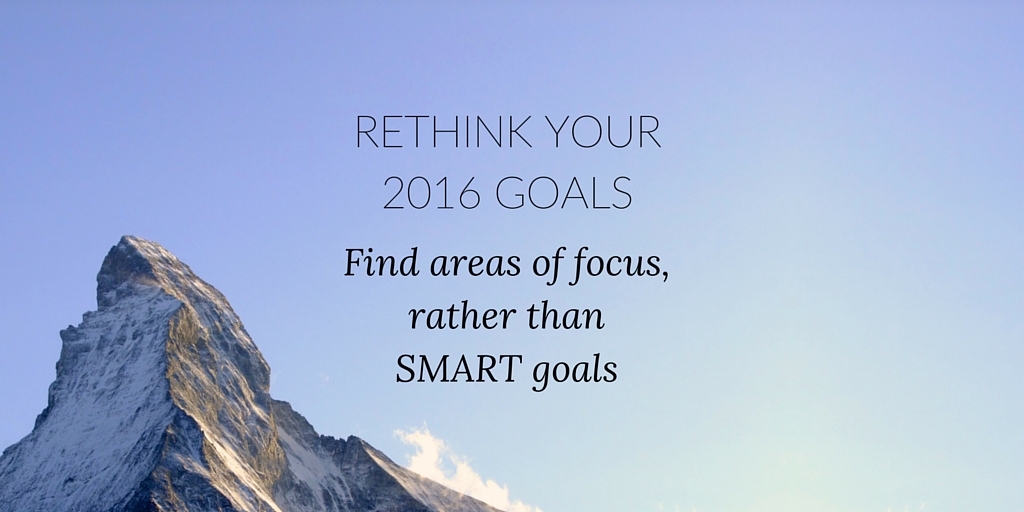
Find areas of focus, rather than SMART goals

Rethink Your 2016 Goals - Twitter 2.a - Eleanor Snare

All of my goals last year used the SMART method, which people generally think is a good way of making goals and helping you achieve them. The SMART method means your goals are Specific, Measurable, Achievable, Relevant and Time-bound.

The problem is, life isn’t SMART. Lots of types of goals aren’t SMART. You can use SMART steps to achieve a goal (more on that later) but often our big goals aren’t going to fit neatly into these boxes.

I found that when I articulated my goals in SMART ways, I ended up doing the bare minimum to fulfil the terms of my goal’s ‘contract’. I didn’t really enjoy it either, as it felt like I was just ticking a box.

As an example, here’s one of my goals from 2015:

By the end of the year I will have written at least two blog posts a month from March to December on fashion, communication or sustainable business.

This felt like a huge chore. When I couldn’t write two posts a month I felt awful about it and when I did write two I wasn’t that excited because it was just part of my ‘to do’ list.

For 2016, I skipped the SMART description and looked at bigger areas of focus. Articulating my goals around these areas has made them much more enjoyable and - so far - immensely achievable.

The difference between the two is the scope of what your goal encompasses and the phrasing you use. Last year it was about “at least two blog posts a month”. This year, my goal is to:

Create meaningful content and an engaged audience on my website

By giving my goal a focus area I have the freedom to try a range of things to achieve it, rather than tie myself down to a specific output. And I’m focusing less on getting it done and more about whether I’m enjoying what I’m doing.

These sort of goals are about quality, not quantity - for what you’re achieving and the process of doing it.


Choose the right language to phrase your goals

Rethink Your 2016 Goals - Twitter 4 - Eleanor Snare

As a writer I’m obsessive over which words to use and when - but in writing my goals for 2015 I now realise I didn’t consider language, and the impact it would have on my goal-getting process, as closely as I should have done.

Last year, the key verbs in my goals were things like “written”, “lectured” and “organised”; all accurate but pretty dull words. The language wasn’t inspirational or enjoyable, and so my goals weren’t either.

For 2016, I described my focus area goals much more carefully. The key verbs are “enjoy”, “reflect”, “develop”, “strengthen” and “create”; a set of inspiring words that also encourage direct action.

There are more words about what I’m gaining from the goals, like “experience” and “knowledge”, and more value-driven words (like “meaningful”).

Choosing the right language for your goals is very important to help you enjoy and achieve what you set out to do. You’ll remember your goals more easily, and you’ll be more interested in working on them if you feel enthused each time you read them.


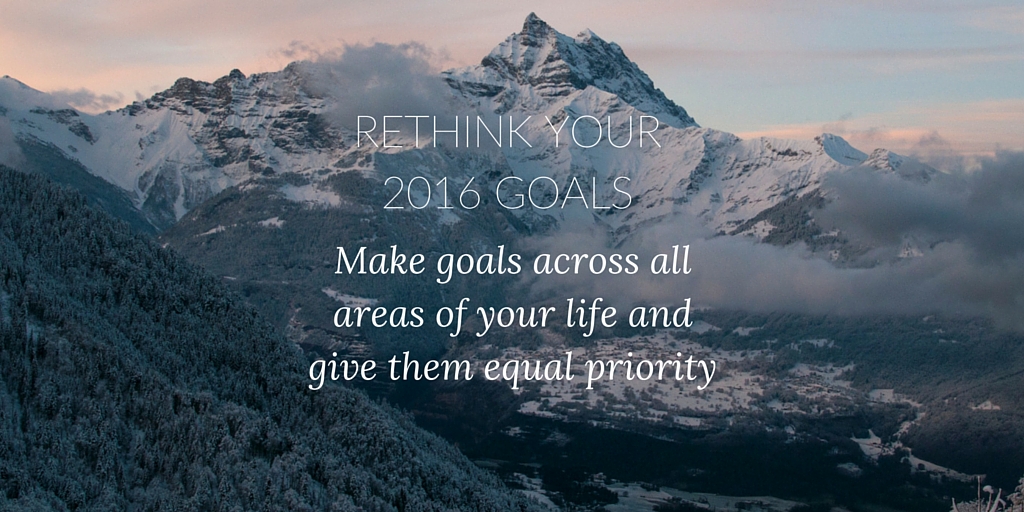
Make goals across all areas of your life and give them equal priority

Rethink Your 2016 Goals - Twitter 5 - Eleanor Snare

Often we set goals in work and education, as part of professional development, but very rarely do we set goals in every area of our life - including family, relationships, health or wellbeing.

Last year all my goals were about work and lecturing, and it meant that I missed out on friendship and personal growth. Reflecting on this, I decided two of my focus area goals in 2016 would be:

Develop my spiritual understanding and knowledge

Strengthen my family relationships and friendships

I chose these goals because they’re two areas I tend to neglect. I enjoy spending time by myself with my head stuck in something fascinating. Yet doing this too much means when I need to tap into that inner strength or external social circle, it’s not there.

These goals aren’t SMART and they’ve got nothing to do with work, but they will have a huge impact on my ability to achieve my other, professionally-focused goals and on my overall quality of life.

Setting focus area goals across all parts of your life, and giving them equal priority, is an important way to gain balance, replenish your energy and enjoy the complete goal-getting process.


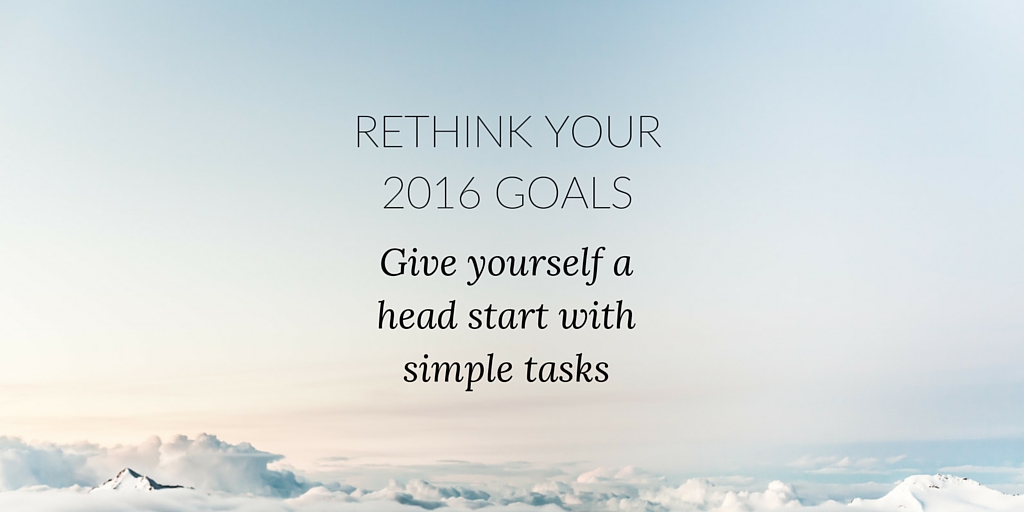
Give yourself a head start with simple tasks

Rethink Your 2016 Goals - Twitter 6 - Eleanor Snare

Setting goals using the SMART method can be limiting, but breaking down goals into simple, SMART-style tasks can be incredibly useful; the same University of Scranton research I mentioned at the start also found people who planned steps to achieving their goals were 10 times more likely to succeed.

I used this method last year, where I broke down each of my SMART-articulated goals into SMART tasks. Because the goals were a like a tick-list to start with, I found that I wasn’t excited by completing the tasks - I was a bit bored.

I also forgot to make all of my tasks completely SMART. More like SMAR.

I missed out the ‘time bound’ aspect because it can be hard to judge when you’ll be able to do something, or how long it might take. Because none of the tasks had time limits, I felt no urgency to do them while at the same time freaking out that I needed to do them now.

While I was achieving things by ticking tasks off, I never felt like I was achieving them.

From this experience, once I’d set my focus area goals for 2016 I created a series of simple SMART tasks which focused closely on the T and were designed to give me a head start on achieving my goal.

I set three SMART tasks for something which I could do…

  • That day
  • That week
  • That month
  • That quarter
  • That year

…which would help me achieve my goal.

I found this process really helpful: I was brainstorming ways to fulfil my goals which I could use later on in the year, plus that day I did three things to help me get a head start on each of my big goals!

Taking a focus area goal and breaking into simple, SMART tasks is a useful way to get a head start on goals which can feel particularly nebulous in January - like setting small milestones for the rest of the year.


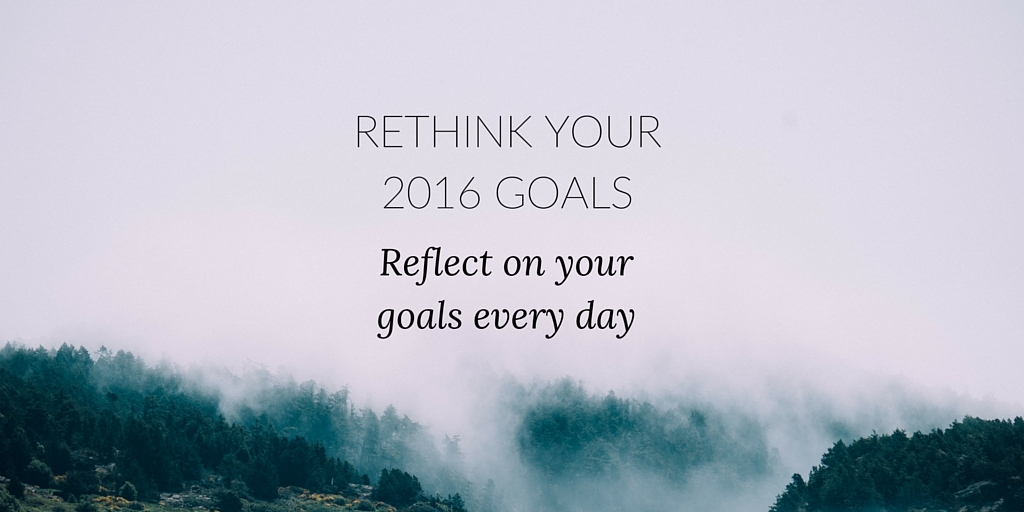
Reflect on your goals every day

Rethink Your 2016 Goals - Twitter 7 - Eleanor Snare

When we’re setting goals for work or education, they tend to be quite far apart; three months is maybe the minimum gap for a PDP meeting. That means we return to our goals to reflect on them only four times in a year.

In 2015, I was reflecting in a similar pattern on my goals. I returned to them to reflect when there was a big change, or I had a spare half day.

Because they were so specific, so tick-listy and a little bit boring, I didn’t want to reflect on them too closely, so I often skipped it completely.

The result was that I didn’t really experience any joy in working on my goals, or any pride when I had hit small targets. It was only at the end of the year, when I was considering goals for 2016, that I finally saw what I had achieved and fully reflected on what I had been doing.

This year, my aim is to reflect on my goals - along with all elements of my life - on a daily basis through reflective writing. Plus, my focus area goals and simple SMART tasks are in a document I look at least three times a week.

By doing this, I’m regularly thinking about what I’m enjoying, what’s not working and what small milestones I’m passing, making the whole process of achieving the goal much more pleasurable.

♦

Summary

My goals for 2015 were exactly what I needed that year to help me manage my work.

But what I learnt from them has helped me to create goals for 2016 which I actually want to achieve - and I feel like I am achieving them in a small way each day.

Here are the five ways to do the same:

  1. Switch to focus area goals
  2. Use inspirational, value-driven language
  3. Make equal-priority goals across each part of your life
  4. Get a head start with simple SMART tasks
  5. Reflect on your goals every day

To help you rethink your 2016 goals, I’ve created a free workbook to print out and fill in. It takes you step-by-step through each of the things I’ve learnt, plus gives you plenty of inspiration for setting goals.

Get the workbook on reconsidering your 2016 goals and making them more enjoyable right here.

Thanks for reading. I’d love to hear about your goals for this year and your progress - let me know in the comments or drop me a line: [email protected].


dark leaf

The Mindset Stopping Creatives Fulfilling Their Potential

Have you ever heard a member of your creative team say “I can’t do that”?

What about “I’m no good at this”?

Or “I’ll never be able to do it”?

We’re all critical of our own abilities sometimes, but if you’ve heard phrases like that coming from your team, they might be suffering with something more than just critical thoughts. They might be suffering with a mindset that’s stopping them from fulfilling their potential.


How do we get to be good at things?

In 2006, psychology professor and researcher Carol Dweck published a book which outlined the culmination of research on our understanding of where intellectual and cognitive ability comes from. Dweck established that everyone was on a continuum of “implicit views” about where ability originated; if it was innate and given from birth, you have a fixed mindset, and if it’s based in hard work and endeavour, you have a growth mindset.

Another name for these two mindsets are the entity theory of intelligence and the incremental theory of intelligence. In the first, you have a fixed mindset. In the second, you have a growth mindset.


Spotting a fixed mindset

Dweck found people’s place on the continuum was especially evident in their reaction to failure. People with growth mindsets realise that learning and development comes through failure. People with fixed mindsets see failure as something to avoid, as it’s a negative comment on traits which they cannot change.

As an educator, I’ve seen plenty of students with a fixed mindset. I spotted it through their approach to failure, but also their approach to opportunities to grow; they shut it down as quickly as possible.

Here are a few things I’ve overheard as an educator which are demonstrate a fixed mindset:

“I’m lazy…so don’t ask me to do too much work.”

“I’m not very good at layout…so I’m leaving it until last.”

“I find decision making really hard…
will you tell me what to do?”


The case of the silent partner

Here’s a little anecdote to show how the fixed mindset works for early-career creatives.

I got our students to do a ‘silent partner’ feedback activity. In pairs, students gave their partner four pieces of critical and thoughtful feedback on a recent project. During this, the partner couldn’t speak - they were only allowed to write down feedback.

The pairs then swapped over so each person received feedback silently. Only they were they allowed to discuss it.

Naturally, I expected this to be a difficult activity - it takes a strong person to not immediately defend themselves against criticism. But I didn’t expect my students to hate it.

They interrupted their partners. They told me how much they hated it. They argued that they shouldn’t have to do it. And they all agreed how difficult it was once the session was over.

(This is why I like my students. Because they tell me what they really think!)

Most of us would struggle to accept feedback silently. But people with fixed mindsets find it incredibly difficult. Rather than an opportunity for growth, for people with fixed mindsets criticism feels like a judgment they can’t do anything about.

Feedback for these early-career creatives wasn’t an opportunity for growth, but a barrier they couldn’t overcome.


What’s so bad about a fixed mindset?

No personality trait is better or worse than another - they’re simply attributes. But certain attributes are more useful for certain careers or lifestyles. Having a fixed mindset is the one thing which will prevent an early-career creative from fulfilling their potential.

The realism of a fixed mindset is useful, especially when you’re talking about your own skills. I can say I don’t have a head for numbers, rather than believing I have an infinite capacity to become the world’s finest accountant.

But sticking with a fixed mindset means you can’t progress from that realism. It turns attributes into barriers. It attaches negative emotions like shame or fear to traits, making them harder to talk about. And it removes agency - our ability to change things - from our own skills.


A fixed mindset in young creatives

Early-career creatives are presented with things they haven’t done before on a daily basis. I’m always throwing new ideas at my students to see what’ll stick. They’re asked to do things which are difficult and they might not be very good at them.

Early-career creatives with a fixed mindset are much less likely to progress in their career than those with a growth mindset, because people with growth mindsets give new things a try, even when they think they might fail.

Creative processes like coming up with ideas and expressing yourself are risky, because you’re exposing yourself to others. Early-career creatives with a fixed mindset are likely to hold themselves back because they believe they’re no good at coming up with ideas, or that they’re no good at expressing themselves.

The student who said they’re lazy will always miss out on opportunities where hard work is involved.

The student who said they’re not very good at layout will always miss out on opportunities to develop design skills.

And the student who said they hate decision making will always miss out on opportunities to lead.


Fixed mindsets at work

Abi Manifold, a friend and leadership consultant with QA Learning, works with businesses on developing growth mindsets. Here’s what she says about the problems of fixed mindsets in the workplace:

“Fixed mindsets kill innovation, because people are scared to fail. Instead of being celebrating for trying they are ‘blamed’ for when things don’t go well first time. In some organisational cultures, there is [lots of] blind conformity because the risk of going out on a limb is greater than any potential benefit of success.


Fixed mindsets mean organisations don’t learn from their mistakes. Mistakes happen and then can be valuable lessons! Instead of using that new found knowledge, organisations waste precious resources scapegoating.”

Early-career creatives going into work will also find a fixed mindset potentially damaging. Abi again:

“[They] need a growth mindset to cope with today’s employment markets. They’re going to get knocked back more times than they get accepted…they really need a growth mindset to survive mentally in this climate…


On a personal level people [with a fixed mindset] may perceive their career or life path is pre-determined and that nothing can change regardless of any effort they make, therefore they make less general effort or (more damagingly) less discretionary effort when things get challenging.”


How to encourage a growth mindset

The most uplifting element of all this is that Carol Dweck points out fixed mindsets are not, in reality, fixed - they can be changed.

It’s a slow process to encourage early-career creatives to have a growth mindset, but the benefits for them and your business are significant. Here’s Abi:

“[Having a growth mindset results in] empowered people, who know it’s ok to try stuff and not get told off…people will make more effort if effort is what we celebrate!


We untie our shackles to concepts of perfection, and we accept each other as imperfect beings. [We’re] less likely to maintain a blame culture, because we focus on what we learned, not who did what and when.”


12 simple tactics

I’ve developed 12 simple tactics based on three core techniques which can be used in the office or the classroom to encourage growth mindset in creatives. They really do work - even after one semester my students were more willing to share ideas, work on feedback and push themselves.

Here’s one of the tactics I regularly use with my students to help get rid of worries around failure: time limits on coming up with ideas.

When this is for a client or a deadline, this process is high-stress. But if there are a spare fifteen minutes in the day, ask your team to come up with fifteen (or more) creative ideas for a new client, business development or new product. Or try five minutes and five ideas (over 15 minutes and I find their energy runs out). Generating ideas like this is fun, fast-paced, and significantly reduces worry about failure because it’s about volume, not ‘perfect solutions’.

I’ve also found some of strangest and most interesting ideas emerge during these short-burst sessions. Because creatives are looking to fill a list, they’re less likely to discard an idea which seems unlikely.

My students found this challenging at first, but over the course of just one semester it’s helped them to be more open and radical with their ideas - and more willing to pitch in during group brainstorming.


Get the rest for free

You can get first-hand access to these twelve tactics by signing up to my monthly newsletter of must-see world-changing fashion and ways to fulfil potential.

This full, free resource includes:

  • 12 easy tactics to develop a growth mindset based on three key techniques
  • Ways to use these techniques by yourself and encourage your own growth mindset
  • Bonus: printable illustrated quotes about growth mindset
  • An online and print-friendly version

—-


—-

Sign up below or click here to gain access to these useful (and actually-used-them-in-real-life) tools!


Thanks for reading.

Signature ES2.1


Photographs: All photographs via Unsplash


10 Stand Out Bloggers to Read to Help Kickstart Your Writing

This post is an aside from my monthly fashion / anti-fashion content. Read about that project right here.

The second rule of my three-rule blogging mantra is carve out your niche.

But how do you do it?

How do you find a unique voice in an increasingly over-populated market?

Finding the project that makes you jump up and start writing, makes you tell everyone about what you’re doing and makes you passionate can take a long time. It’s only this year I feel like I’ve started a project that will truly inspire and motivate me for twelve whole months.

There’s also a host of inspiring bloggers online who motivate me. Each one adds something different to my reading list, and I wanted to share them with you.

Take a look at my list of stand out bloggers and ask yourself:

What’s their niche? Is their passion clearly defined?

How do they stand out? What makes them different from others in their field?

And most importantly…why do you think I’ve chosen them?

10 Stand Out Bloggers to Motivate You

Avant Blargh
Avant Blargh
Final Fashion
Final Fashion
Already Pretty
Already Pretty
Miss Lucy Loves
Miss Lucy Loves
Mod Hijabi
Mod Hijabi
TQS Magazine
TQS Magazine
A Little Bird Told Me
What I Wore 2Day
What I Wore 2Day
threadbared
Threadbared
Whip Until Fluffy
Whip Until Fluffy

Every time you read something online, visit a website or find a new blogger, ask yourself those questions. Analysing how others carve out their unique niches will help you establish your own. Importantly, if you visit a new blogger and think they’re not unique, ask yourself why - it could help you avoid the same pitfalls.

You can see the other bloggers I regularly read on Bloglovin’ - don’t forget to follow me there for updates.

Which is your favourite stand out blog? Tweet me @ebsnare with your thoughts.