Ethical Fashion Alternatives for SS16

Question: What do you do when you love fashion, and you love trends, but you’re committed to shopping ethically and sustainably?

Answer: You scour the web for products made fairly and made ethically that just happen to be completely on trend, and add them to rather lovely Pinterest board.

Then you write an article so other ethical fashion shoppers know where to look.

So, here are my picks of ethical fashion alternatives for four SS16 trends.

The incredible earrings featured in this image are from Palomita Jewellery - visit their Etsy shop here.


SPORTS SHOES

The sportswear aesthetic is still very strong, probably because it’s very comfortable and practical (unlike a whole lot of other trends).

Although a class pair of adidas stripes look great, the company isn’t well-rated when it comes to ethical production.

Here are some alternatives (in timeless black).


EYE-WATERING BRIGHTS

This trend is inspired by Gucci and other designers who used acid colours and clashing patterns on the SS16 catwalk.


REVAMPED 90S

Some things about the 90s I wish were left back in the past (scrunchies, for example). Other trends, like casual dressing and grunge styling, I’m happy to see renewed and revamped with spring colours.


HUGE EARRINGS

An accessories trend exemplified by Gucci but popular on high street shows too: big, bold, over-the-top and mismatched earrings.


Thanks for reading. Have you spotted any more ethical fashions that fit in with this season’s trends? Let me know on Twitter!


Is a Blog Better for My Business Than Social Media? | Eleanor Snare

Is a Blog Better for My Business Than Social Media?

I love writing articles for my blog, whether that’s on catwalk trends or how to make fulfilling your goals for this year more enjoyable.

But like other small businesses and creative entrepreneurs, I’ve got my fingers in lots of digital marketing pies; I also enjoy writing articles on LinkedIn, and sharing photos on Instagram, and starting interesting conversations on Twitter.

These channels are continuously developing their functionality, whether that’s increasing character count or linking up with other platforms, and using them for marketing is more exciting than ever.

So the question is - is a blog better for my business than social media?


SLICK WEBSITES + SUPER SOCIAL MARKETING

Services like SquareSpace now offer beautifully-designed, seriously pared-back websites for entrepreneurs and businesses. If you have a bricks-and-mortar retail store, the idea of having a website that’s anything more than a clear and communicative home page seems a bit unnecessary.

And if you can now gain customers from your carefully-curated Instagram feed or Twitter recommendations, you might not need to convince people with length blog articles.

Long-form writing isn’t right for every business. It takes time, planning, and resource dedicated to dreaming up and getting down on paper lots of relevant ideas which you and your customers will benefit from.

But there are still plenty of reasons to have a blog for your small business, and keep it regularly updated.


IT’S ALL YOUR CONTENT UNDER ONE ROOF

The most important thing for me about my blog is that it’s got all my ideas and support for clients under one roof. Rather than direct clients to an insightful Instagram photo from six weeks ago (which will take me ages to find anyway), I can direct them to a blog post which is simpler to find thanks to good categorisation and tagging.

A blog means you can link articles to other articles easily, showing clear connections between your ideas and sending potential customers on a journey (which encourages them to stay longer on your site).

It’s a portfolio of your expertise that’s easy to gather together and direct people to; spreading yourself across multiple social media channels means getting people to stick around and ‘join the dots’ is a lot harder.


IT’S YOUR PROFESSIONAL BRAND AND VOICE

While increasingly we’re seeing visual content take the place of the written word, and entrepreneurs are encouraged to explore infographics, photo tutorials or video, clients still want to absorb you through what you say in person and in writing.

That’s why Instagram photographs have captions and even the shortest emails can take hours to craft.

Keeping a business blog means you can articulate your brand through a clear tone of voice - a personality that helps people feel as if you’re really there with them.

Video is another key way to create this, but not everyone is confident on camera (and it takes real skill not to fidget, mutter or waffle).

In a blog post, you can be yourself - a crisp, edited version of yourself that speaks directly to your client’s needs.


IT DEMONSTRATES YOUR USP

I’m going to go out on a limb here: while all other digital marketing channels for entrepreneurs, especially social media, can be populated with curated content without any negative repercussions, only your blog has to be original.

On Instagram, Twitter and Pinterest you can re-post, re-tweet and re-pin other people’s content; in fact, that’s actively encouraged. On LinkedIn, sharing and reacting to other people’s updates is seen as a good networking strategy, and the articles are often repeated content from personal blogs or brand websites.

But on your blog, the idea of using someone else’s content or not writing something original is frowned upon - both by customers and by Google. Even Buzzfeed, the king of curated content, writes every blog article from a unique point of view, linking together images and ideas in an original way.

Your blog is the way for you to show your originality and demonstrate your business’ USP. You should be doing that on social media, but you’ll also be curating and sharing other people’s ideas; other people’s USPs.

Your blog is for you, your USP and your customers - not anyone else’s.


IT BUILDS TRUST IN YOUR BRAND

Showing your USP and your tone of voice very clearly on a regularly updated blog can also build real trust in your brand. This can be the difference between a client considering you as an option, and actively wanting to work with you - whether they take that next step on the customer journey towards conversion.

Having a regularly updated blog will not gain you more customers as a small business if the rest of your website doesn’t have key information a customer needs. This includes opening hours, clear descriptions of services and contact details.

Some customers aren’t bothered about a blog. In BrightLocal’s 2016 survey of 800 American consumers, only 2% said a blog was important on a local business website and just 3% said not having a blog would stop them from shopping with a local business.

But in a saturated market, having an informative, helpful and well-written blog can be the difference between a potential customer and an actual customer. From BrightLocal:

We should clarify that these [like the blog] are good features to have; they will help to inspire trust, establish expertise, answer more tricky questions & even encourage return visits from knowledge hungry customers.

And looking at the stats from their survey, helpful content features like FAQs, customer testimonials, accreditations and a blog are all more important to customers than they were in 2014 - so investing in a blog now could prove very fruitful in the future.


IT GIVES YOU CONTENT FOR SOCIAL MEDIA

One of the biggest struggles about using social media to promote your small business is thinking of what the hell to talk about. Because of the suggested frequency of some of the channels - for example, five times a day for Twitter or twice a day for Instagram - it can be a real struggle to find interesting, relevant content to share with your customers.

As a recent client of mine said, “This social media stuff’s a full time job!”.

Writing for your blog gives you something to share on social media - it’s that simple. You can share your blog posts multiple times in multiple ways on social media, giving you something fresh to talk about on a regular basis (as well as showing off all the good stuff I’ve already mentioned, like your tone of voice and USP).

Rather than simply ‘moving’ content around in the big community of social media through re-tweets and re-posts, you’re adding to the community.


IT KEEPS GOOGLE HAPPY

There are many more exciting things in this life than SEO, but it’s a bit like death and taxes; you can’t avoid it. Considering SEO means you’re considering Google, and considering Google means you’re considering the shopping and search habits of the millions of people who use it every day.

An informed, original, consistent blog for your business means your website is regularly given an injection of content - what Google refers to as ‘freshness’. And the freshness of a website directly affects whether it appears in search ranking or not.

So does the number of people linking to and sharing your website, which is much more likely if you write about things your customers are interested in and find helpful.

Having a blog means your fresh, original content is under your roof (not Twitter’s or Instagram’s) so Google is more likely to display your site in search results and your potential customers are more likely to discover it.


If you’re a small business or an entrepreneur, having a blog on your business website isn’t always going to be the right option; you might find more success in social media, email newsletters or traditional marketing.

But a lot of the time a blog is ignored because businesses don’t have the time, energy or skills to keep it going, even if it might be one of the most successful and cost-effective marketing channels to reach their customer.

Taking the time to work out your customer profile, where they hang out and what sort of content they’ll respond to is key to understanding whether a blog is a waste of time - or an incredibly good investment.


Thanks for reading.

If you know your blog is a great way to reach your customer but want some much-needed support, get in touch to find out how my cost-effective copywriting packages can help you make the most of your blog and social media marketing: [email protected]


photo-1441984536979-3513fd89f0d0

Clever Retail Ideas for Small Businesses and Creative Entrepreneurs


If you’ve read my article on how to make the most of your retail space, you’ll now be looking for some tactics to make sure your shop, market stall or pop-up shop gets your customers to help achieve your business aim.

There are plenty of ways to find inspiration for your retail space. One you can do from the comfort of your armchair is browsing (ok, ‘becoming addicted to’) Pinterest.

But don’t search for ‘retail ideas’ because you’ll get the images everyone is seeing.

Instead, search for home trends, storage solutions and other more personal visual merchandising and display tactics.

For small businesses, these are often more cost-effective and innovative than trying to fit the latest Parisian concept store idea into a tiny retail space.

Don’t forget, your tactics should fit with what your customer needs and wants, and what you want to achieve from your retail space.

Here are my five favourite, clever retail ideas for small businesses and creative entrepreneurs.

Clever Retail Ideas for Your Small Business Eleanor Snare


(1) Use a feature wall to draw a customer’s attention to the till or key product area.

(2) Install modular display units you can move around to fit new products and renew customer interest.

(3) Display small products inside larger items to show contrast and intrigue customers.

(4) Combine hanging window displays with information to attract and educate your customer.

(5) Show your inspiration or work-in-progress in simple ways to help customers trust your story.


You can find more inspiration by following me on Pinterest and Instagram, where I share marketing ideas and more. See you there!

Thanks for reading.

Liked this post? You might enjoy these ones too:


photo-1449247666642-264389f5f5b1

How to Make the Most of Your Retail Space as a Creative Business

In this article I wrote about how I didn’t want to shop at a retailer where the product’s value wasn’t being communicated through proper visual merchandising or service.

This time, I want to use those thoughts to help small, independent retailers fulfil the potential of their shop space.

The shop floor is just as much a marketing channel as your website or lookbook, and there are always ways to make your retail space more effective, interesting and meaningful for customers.

(If you don’t have a retail space, you can still use this article to help you fulfil the potential of your ecommerce site or market stall).

Here’s how to make the most of your retail space in a way that’ll achieve your business aims and please your customers.

How to Make the Most of Your Retail Space - Eleanor Snare


FIRST, FOUR QUESTIONS TO WRITE DOWN

First, stop asking yourself “What do I want to sell?”. Selling stuff is a strategy to help you achieve a bigger business goal (like steady income).

To really fulfil the potential of your physical retail space, you need to ask yourself these four questions instead:

  1. “What do I want to achieve with this space?”
  2. “What is the customer journey in this space?”
  3. “What does my customer need from this space?”
  4. “What does my customer want from this space?”


WHAT DO I WANT TO ACHIEVE WITH THIS SPACE?

Your retail space is the physical expression of you, your business and your brand. It’s not just a place to sell stuff. So thinking about what you’re trying to achieve with it is essential to fulfilling its potential.

Your main aim for the space will tie directly to your business objectives and will probably be commercial. For example:

  • My aim is to encourage repeat purchases
  • My aim is to sell high-ticket items
  • My aim is to have every person who walks through the door buy something

But you might also have some aims not related to sales but definitely linked to the perception of value you want your brand to have. For example:

  • My aim is to make the space feel relaxing and welcoming
  • My aim is to exude coolness and ironic trendiness
  • My aim is to express the creativity of my brand

Select the most important of these aims. These are what will shape your store.


How to Make the Most of Your Retail Space

PSST…COPY THE BIG BOYS

You can split up your store space (or ecommerce site, or market stall) into smaller sections which could have different aims.

This is what big retailers do, and it’s why:

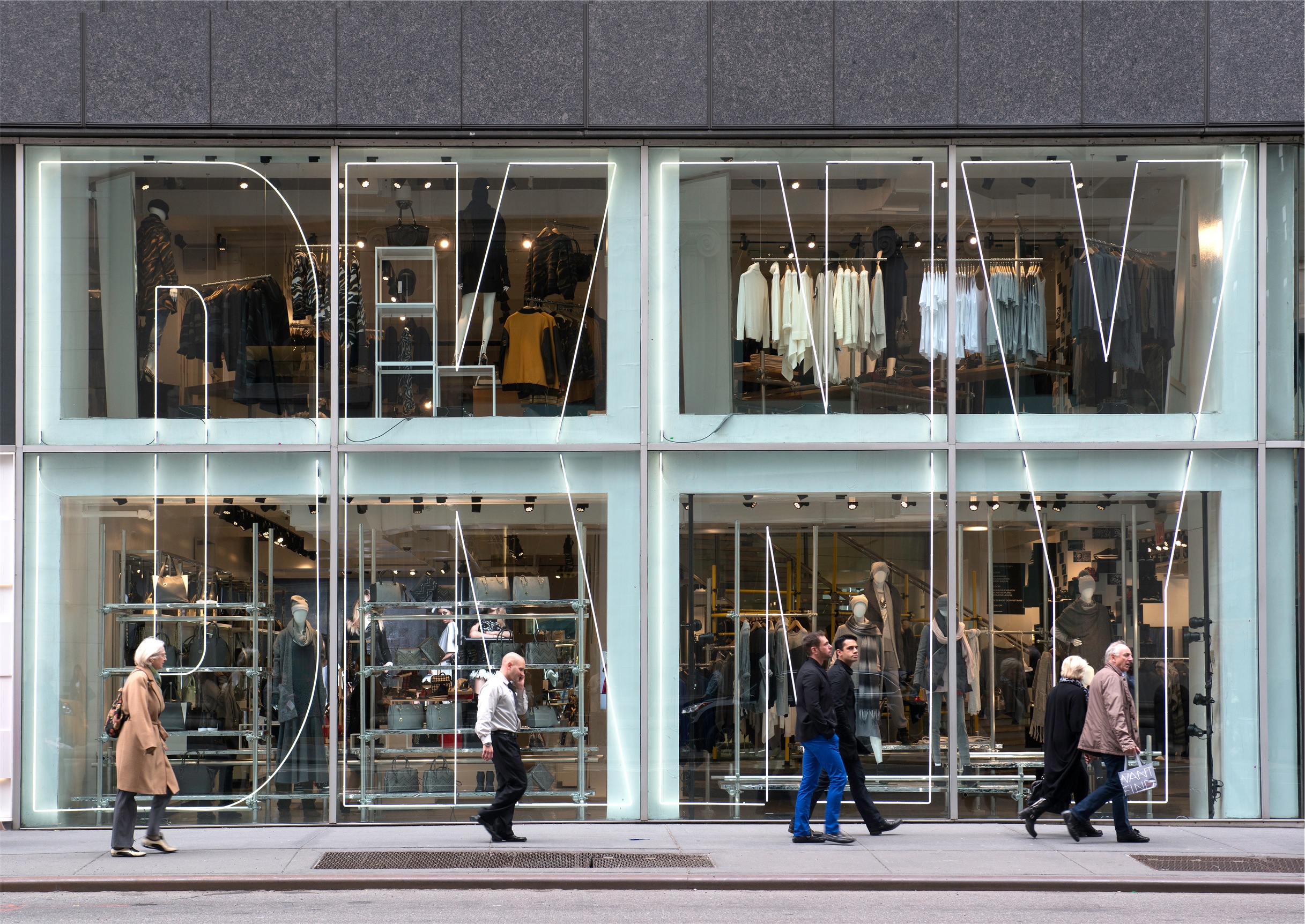
  • Shop window displays always have the most exciting items (and tiny printed prices)
  • Low-ticket items are placed near the till
  • Grocery essentials are put round the edge of the supermarket, not the centre

These smaller spaces are all trying to achieve different aims which reflect different stages of the customer journey.


WHAT IS THE CUSTOMER JOURNEY IN THIS SPACE?

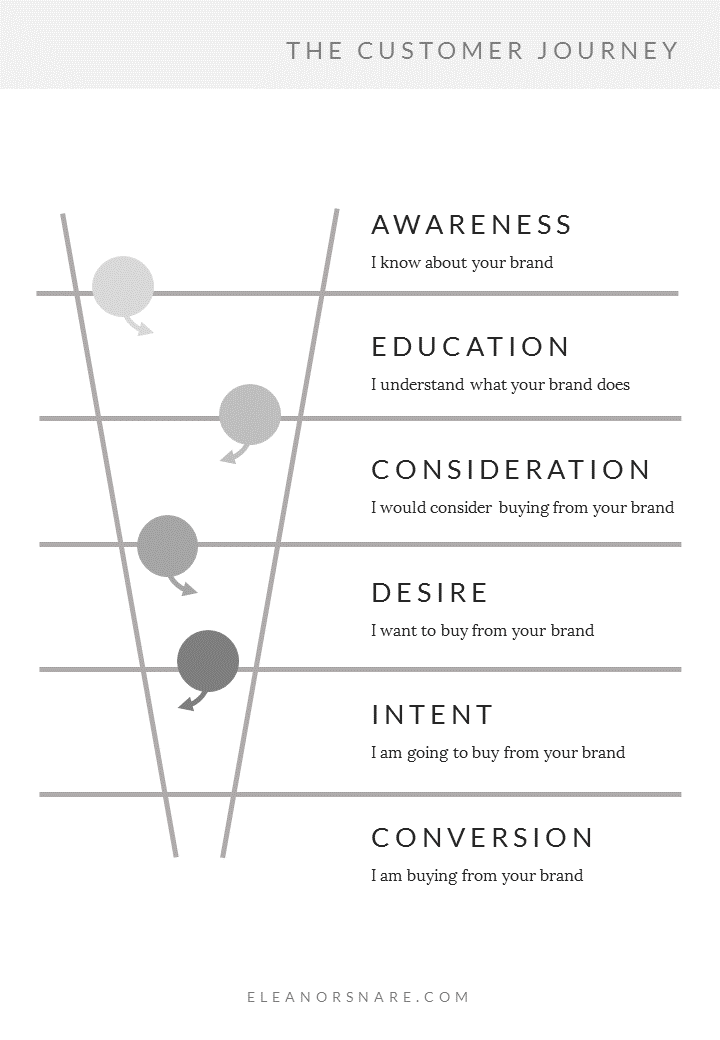
The customer journey has lots of different variations but the basic premise is the same: customers go from not knowing anything about you, to knowing about you, learning more and eventually buying from you.

The number of customers gradually decreases the closer you get to purchasing - that’s why the customer funnel makes sense (more go in the top and only a couple come out the bottom).

I use this version:

Customer Journey Portrait

Here’s a flavour of how the customer journey works with a physical store:

  • “Oh! You’ve got a shop.” (Awareness)
  • “And you sell those tiny boxes I like.” (Education)
  • “They’re pretty too.” (Consideration)
  • “At that price, they would be an absolute steal.” (Desire)
  • “Do you take card?” (Intention)
  • “I’m so glad I popped in!” (Conversion)

This is a very simplified version, but you can see how it works.

The journey ends with your business aim (the ‘conversion’ point) and the whole journey is geared towards achieving that aim. Here, it’s what you want to achieve for your physical space.


THE CUSTOMER JOURNEY IN YOUR RETAIL SPACE

In a retail store, different areas are designed to respond to different parts of the customer journey as the customer travels around the shop. The idea is to get them to move on to the next stage in the journey.

Here are some examples:

  • Awareness - window display and outdoor advertising
  • Education - main in-store display area with range of products
  • Consideration - specific product area with range of sizes
  • Desire - display card mentioning product USP
  • Intention - clearly displayed Visa and Mastercard logos at the till
  • Conversion - till point itself

This is how the most successful businesses think of their shop: not as a space to flog stuff, but as a way to achieve their business objectives by enticing customers onto the next stage of the journey.


Thinking about your store in this way will do two things:

  1. It will help you achieve your aim for the space
  2. It’ll give customers what they want

Designing your store around your aim and the customer journey gives customers what they want because you have to know the customer to get the customer journey right.

(Read more about knowing your customer here).


How to Make the Most of Your Retail Space


WHAT DOES MY CUSTOMER NEED FROM THIS SPACE?

The customer journey links directly to the third question: what does my customer need from this space?

First, use the customer journey to work out what a potential customer would need to experience in your shop’s physical space to make it to the next stage of the journey. These aren’t nice-to-haves; these are essentials.

For example, if you don’t have clear signage outside your shop or on your stall, customers won’t be aware you exist. If you don’t have displays which contain a range of your products, they won’t be educated about what you sell.

Take it step-by-step through the journey and you’ll be able to work out the things they need. You’ll also understand the barriers which you might’ve put up which will stop them from moving to the next stage of the journey.


TAKE AWAY BARRIERS FOR YOUR CUSTOMER

The reason I mention barriers is because lots of independent and small retailers are good at (1) - they know their customer or potential customer and what they need. But they’re not always that good at seeing and removing barriers to that customer journey.

For example, I’ve been in independent retailers with multiple stockists where it’s hard to tell different makers apart due to poor signage or poor layout - which is a barrier to consideration.

On craft stalls, the products might be beautifully displayed and labelled, but if the owner is ignoring passers-by it creates a barrier to desire.

And one of the most common barriers to intention is not having a card machine.

Your shop space should make it as easy as possible for customers to progress through the customer journey quickly and simply. Think about what they need and try to remove barriers wherever possible.


WHAT DOES MY CUSTOMER WANT FROM THIS SPACE?

After you have your aim for the space, you understand the customer journey, have given them what they need and removed barriers, you can start to consider what customers want from the space.

You’ll have an aim for your retail space that’s sales focused. But you’ll also have an aim which is more focused on how the value of your brands and products are communicated. This is where to start with what your customers want from the space.

Although it’s your aim for your brand and how it’s valued, always start with your customer and how they want to feel. So if you want your store (and your brand) to be seen as relaxed and welcoming, ask yourself what your customer would want to feel relaxed and welcome - not what you want.


How to Make the Most of Your Retail Space

STOP THINKING ABOUT YOU

I think this is one of the hardest things for independent and small retailers. If you’re an entrepreneur with a strong vision and personality, it’s hard to suppress that and think of your customer first - especially if you have loads of creative and innovative ideas.

But your shop is not about you. It is about making it easy for your customer to help you achieve a business aim. Without them, your brand will not survive.


START THINKING LIKE YOUR CUSTOMER

Each business’ customer will be different, and a clear customer profile will help you work out what their desires and fears are. How they shop and spend money are important elements to consider.

A recent example we discussed with my students were concept stores, which look incredible and can communicate the value of the brand very effectively.

But they only work if your customer wants that. If you have a product display with only one of everything, some customers will be too fearful to buy anything. Others will love the idea of being completely unique. You need to know your customer first.

Here are some questions to get you started:

  • Does my customer want luxury, or everyday?
  • Do they want aspirational qualities, or accessible qualities?
  • Does she want innovation, or tradition?
  • Does he want uniqueness, or belonging?


TACTICS TO MAKE SURE EVERYONE IS HAPPY

Your answers to all these questions will help you design tactics to create a space which will achieve your aims. By now you should have:

An aim for your space which is commercial.

An aim for your space which is focused on communicating your brand.

An understanding of the customer journey in your retail space.

An understanding of what your customer needs from the retail space.

How to remove any potential barriers to the customer journey.

An understanding of what your customer wants from the space.


By putting all these answers together, you have a set of criteria. Using these criteria, you can start to develop visual, personal and physical tactics which fulfil all these elements and make the most of your retail space.

You can find some inspiring ideas to get you started in this article on Clever Retail Ideas for Small Businesses and Entrepreneurs.


I’d love to hear your thoughts. Let me know on Twitter or share your comment below.

Thanks for reading.