Why Joe Fresh is a Lesson that The Fashion Industry Needs to Listen To


Encouraging systemic change in the fashion industry is a bit like encouraging people to deal with self-sabotaging behaviours. The first step is to admit you have a problem.

And for every figure – like Stella McCartney – who admits there is a problem, there are far more who deny systemic change is even necessary.

Fashion designer and founder of the Canadian brand Joe Fresh, Joe Mimran, was recently interviewed in Toronto Life about his step down from the company (and new role on Dragons’ Den).

In 2013, Joe Fresh was one of the brands implicated in the Rana Plaza collapse, where 1,134 people died. A garment factory in the building manufactured clothing for them and other brands. Loblaw announced it would send reps to Bangladesh to investigate, and victims’ families would be offered compensation.

In his parting interview, Mimran didn’t admit his brand had a problem. He demonstrated the shift of responsibility that’s problematic in the industry: who is in charge of making sure people are ok? The arguments he used denied the necessity of systemic change, and they’re arguments lots of people in the industry will be using (and facing).

Unpicking some of them will hopefully make a stronger case for change. Each of the italicised and indented Q&A is taken from the original interview.

8731789941_0d712ef932_o

Brand responsibility

Joe Fresh is facing the threat of a $2-billion class action lawsuit from the victims of the Bangladesh building collapse. They claim Joe Fresh had a responsibility to ensure the building’s safety. Are they right?
The question is, how much oversight should companies have when they contract labour overseas? Should we be doing engineering checks on the buildings? No other industry does that. But it’s a responsibility that has now been forced upon the apparel industry because of the disaster.

Mimran clearly doesn’t like the idea of the apparel industry being ‘forced’ to take responsibility for the welfare of its workers. In this instance, it might be because there is no PR-friendly angle. Free childcare, healthcare or women’s education – key elements of worker welfare overseas – feel nicer than structural building checks.

The idea that worker welfare extends to a worker’s environment as well as their physical being isn’t new: in the early 1900s, Joseph Rowntree built good quality homes for his confectionery factory employees to prevent them living in slums.

However, if your workers aren’t on your doorstep, what’s the protocol for welfare? Mimran does inadvertently address a key argument about systemic change head on: “How much oversight should companies have when they contract labour overseas?” His argument leans towards ‘out of sight, out of mind’. But a company like Marks and Spencer, who rigorously control their supply chain, would say differently.

Would Mimran be as blinkered if the factory was in Toronto? Humans aren’t really built to deal with the complexity of the world (just try imagining seven billion people) so when something is in our field of vision – like Rowntree’s factory and nearby village – it tends to feel more important.

In technical terms, the further production moves from the site of consumption, the weaker our mental link between the two becomes.

A weak mental link between the two starts to erode the visibility of supply chains. To contract labour overseas might mean asking one audited factory to produce 20,000 garments. Or it might indirectly mean asking four non-audited sub-contractors to produce 5,000 garments.

In some of the countries where fashion labour is densely concentrated – including Bangladesh, the home of Rana Plaza – there aren’t bureaucratic systems in place to prevent this multiple sub-contracting, or to make supply chains visible. And why would there be, if fashion brands continue to employ producers with the current set up?

For companies keen to monitor their entire supply chain, there are then two jobs to do. First, encourage bureaucratic systems of transparency and worker welfare. Second, look at your own supply chain choices very closely.

For Mimran, and for plenty of other brands, that’s just too much work.

45228666js_14_f

Clothes aren’t like food

What did you make of John Oliver’s stunt on Last Week Tonight where he sent cheap food of dubious origin to the Joe Fresh office to mimic the garment industry’s production practices?
I think what you put on your body and what you put in your body are two different things. But the stunt brings attention to a very serious subject, and it’s one the industry has to solve together.

His answer’s first sentence deserves special attention as it summarises another of the big issues holding back systemic change in the fashion industry.

“What you put on your body and what you put in your body are two different things”. Yes, they are different. But they are fundamentally connected.

Skin is a living part of our body which absorbs, reflects, protects and adapts depending on what we do, eat and expose ourselves to. A specific part of the sustainability movement would argue that mass-produced clothing can be harmful due to manufacturing process and the effect it has on our skin (and body).

For example, waste products from dyeing pollute water systems; plastic-based manmade fibres don’t allow our bodies to ‘breathe’ effectively; and even certain styles of clothing might be unhealthy.

Clothing is not an inert shell we climb into every day. It’s a reactive second skin whose composition affects our own.

Just like interacting with food, the human body interacts with clothing. This is on a physical level, as I’ve outlined. But it’s also on many other levels: political, sexual, ethical, social, cultural. The clothes I wear represent as much about me as the food on my plate. And they both have the same connection to other people – to workers – which is necessary to contemplate systemic change.

Both food and fashion suffer from opaque labour. This is a problem of contemporary capitalism: who makes your bread? Who makes your shoes? But on an everyday level, one of these industries is undergoing a dramatic reconfiguration (at least, for some demographics). The drive for organic whole foods, home-cooked, well-presented, nourishing and tailored to the individual is growing.

It’s mainly concentrated in demographics connected to the Internet (especially visual social media, like Pinterest) with medium to high levels of disposable income and time. These people want to know who made their beer, where their peaches come from, how to make the perfect sourdough loaf. They’re meeting suppliers, buying direct, and using social media to publicise the results.

Of course, there are swathes of people who aren’t doing this, who instead – due to many reasons – receive poor food education and make poor food choices for the health of their bodies. However, neither of these food consuming groups are reconfiguring fashion in the same way as the first are reconfiguring food.

The girl who eats sugar-free avocado brownies will still buy her t-shirts from Primark.

The answer to why that’s not happening is for another time. But we’ll never be able to learn from the food industry to help us make systemic change in the fashion industry if figures like Mimran perpetuate the myth that clothing is an inert shell, that what goes into us is more important than what’s put onto us, or that our experiences of the industries is so radically different we couldn’t possibly see any links between them.

6757860435_e0d0defc90_b

More cash means more improvements

Is there a solution?
For sure. As producing countries become wealthier, they become better able to meet safety standards. It’s what has happened in China and Korea.

Another answer, another shift in who is responsible (or not) for systemic change. Mimran’s cash-rich dream of pumping money into economies in the hope they change does, in part, make sense. But there are a lot of hidden variables.

Safety standards are different in every country. The ‘producing countries’ Mimran mentions – places like Cambodia, Vietnam, Bangladesh, China and Korea – often have safety standards which consuming countries – the UK, America, Canada, or European countries – would consider to be unacceptable.

Unacceptable, that is, if they were in their territory.

Mimran’s argument is to work with producers you know have unacceptable safety standards, because the profits of the producers can then be reinvested in improving the safety standards through education, structural changes, etc.

In the words of economist Joan Robinson:

The misery of being exploited by capitalists is nothing compared to the misery of not being exploited at all.

On paper, I think the cash-rich dream works. But it begins to fall apart as it assumes a number of highly changeable variables:

  • The producers will reinvest profits in safety standards
  • The producers know how to improve safety standards
  • Clients (fashion brands) will check on these safety standards at some point in the future
  • Improved safety standards are of benefit to producers (not just the workers) and something to strive for
  • Producers won’t shift the cost of improvements onto clients
  • Clients will continue to use the producers whether costs change or not

Industry, unfortunately, doesn’t always work like it does on paper.

A company chasing profits will move its labour contracts to the place where they can gain the most profit through low output to the producer. When Mimran mentions China and Korea, he inadvertently nods to the movement of labour contracts from country to country as brands try to find the producing territories where they can gain the highest profit alongside highest quality.

There are too many variables in this idea of ‘more money, no problems’ for it to work in practice. It’s not only on the part of a brand’s desire for profit, but also because producers – especially in those countries mentioned where bureaucratic systems may not robust – might not know (or care) about improving safety standards.

It requires national or at least regional legislation to improve working standards. The idea that money flowing into specific producers in a country automatically makes it wealthier, and that wealth equates to widespread legal changes, is a fallacy.

Boiled down, you can’t give someone money for doing something and then expect them to do it differently if you keep giving them money.

This isn’t an argument to damage economies through removing labour contracts. But it is an argument for the fashion brands contracting labour overseas to be more rigorous, supportive and responsible in their choices. Big brands have big purchasing power, and could do much, much more to fundamentally improve the labour situations of producers through negotiation.

Mimran’s ‘shifted responsibility’ solution won’t work. It hasn’t so far.
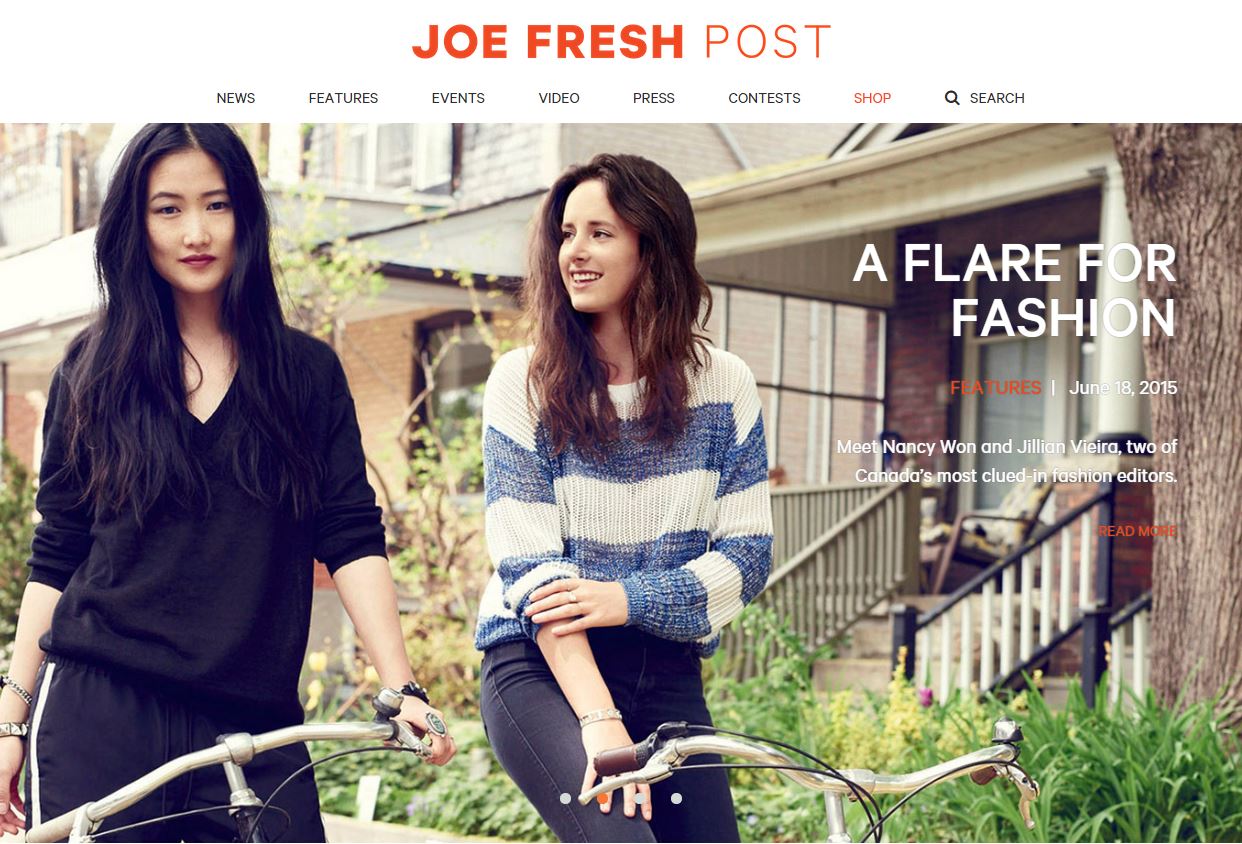
joe fresh 1

Conclusion

Mimran’s interview with Toronto Life highlights three of the biggest arguments around systemic change in the fashion industry.

First, whether a fashion brand is responsible for rigorously monitoring its supply chain, especially when contracting labour overseas, to make sure worker welfare is adequate.

Second, whether clothing affects us in the intimate way food (or other industries, like beauty) does, and therefore whether we can learn from the transformations of one to encourage systemic change in the other.

Third, whether by continuing to contract labour in places where safety standards are low, fashion brands are contributing to an economy which will eventually meet the preferred safety standards through wealth accumulation.

As a supporter of systemic change, my arguments are that brands are responsible; we do have an intimate a relationship with clothing as we do with food; and this economic argument becomes flawed in execution.

By unpicking arguments denying the need for systemic change from figures like Mimran, people interested in transformation of the fashion industry can see where the holes are in commonly-held opinions. We can also start to argue the case much more effectively.


Photographs
Featured: Joe Fresh Fashion Show by Jason Hargrove via Creative Commons
Dhaka Savar Building Collapse by rijans via Creative Commons
Moschino bag from the Moschino e-commerce site
Pile of Cash by 401(K) 2012 via Creative Commons
Screenshot from Joe Fresh website taken 08 July 2015
References
Thanks to C’est Ethica and Sasstainable for sharing and discussing the original interview.
http://www.torontolife.com/informer/people/2015/06/30/joe-mimran-joe-fresh-qa/
https://en.wikipedia.org/wiki/Joseph_Rowntree_(philanthropist)
https://en.wikipedia.org/wiki/New_Earswick
https://en.wikipedia.org/wiki/Joe_Mimran
http://www.huffingtonpost.ca/2015/04/30/proposed-class-action-tar_n_7182964.html
http://business.financialpost.com/fp-comment/peter-foster-2-billion-lawsuit-against-loblaw-joe-fresh-could-damage-the-people-it-seeks-to-help
http://www.thefashionlaw.com/home/rana-plaza-victims-file-2-billion-lawsuit-against-joe-fresh
http://www.ranaplaza-arrangement.org/fund/donors
https://en.wikiquote.org/wiki/Joan_Robinson
http://www.theguardian.com/uk-news/2015/jun/22/skinny-jeans-bad-for-your-health-scientific-evidence

Why Marketing Models Don’t Work for Marketing Students

Here’s a confession: I work in marketing, I teach marketing, and I don’t like marketing models.

My dislike is partly personal – I don’t like making things reductive when they (like marketing) are very complex – and partly professional: people’s heads are turned when a pretty diagram waltzes in the room, whether the content of that diagram is any good or not. And I am all about the content.

For marketing education, these models serve a strong purpose: to show, succinctly, the various different ways you can approach marketing through analysing different data. But can they be more of a hindrance than a help?


What is a marketing model?

A marketing model is a framework that describes actions for the marketer to take, or data for them to analyse, in preparation for doing the marketing strategy. It doesn’t tell you how to do marketing. Often they’ll include diagrams, or a memorable number or acronym.

There are a lot of them about. One of Smart Insights key documents explains 15 “classic planning tools to inform strategy” including the seven Ps, AIDA, push-and-pull, the Ansoff Matrix and PESTLE analysis. Fifteen models to inform your strategy is quite a lot of models. And new ones are being created all the time as marketers and agencies look to differentiate themselves from the competition.

I’ve used a number of marketing models before and they do ‘work’. But that’s part of the problem. As Smart Insights say, these are tools to “inform strategy”. They’re not tools to tell you what the strategy is. In marketing education, I think this can be a sticky subject.

Answering the question of whether marketing models are useful for students or not first means looking at their strengths and weaknesses.


The strengths of marketing models

Marketing models do work effectively when they’re used in the right way. Their key strength is they’re a lens through which to view things: they alter your perception, help you focus and highlight clues through pointing to areas you might not have noticed before.

Because many of the marketing models have developed over a number of years (some dating back to the 1940s), they’re pretty well-defined, which make them useful for students just starting out. There are also plenty of models to choose from when planning a marketing strategy. While this could be seen as a weakness – too many choices! – I think it has two strengths.

First, students can find the model which makes most sense to them, whether it’s a diagram or acronym.

Second, the best students will use multiple models and cross-check their information, looking at the data from a range of viewpoints. For example, a SWOT analysis and a PESTLE analysis work very effectively together, as the first looks at specific, often internal criteria, while the second looks at wider-ranging external criteria.

Marketing models are also widely understood (if only by people who work in marketing). That means the models are a good shorthand for students going into industry, helping them understand what their new team are discussing and giving them a way to present their own ideas. However, it’s useful to remember every business will have their own unique way of interpreting any model.

Finally, and most simply, a good marketing model is like a ready-made checklist. That means once you’ve completed it, you know you haven’t got any gaps. For marketing newbies, this is really helpful.


The weaknesses of marketing models

While marketing models do provide a clear framework for students, a critical weakness is their rigidity. Because they present a limited number of criteria to explore, there’s the risk of basing strategy on data that’s incomplete or reduced to a table-friendly format. Part of marketing is the incalculable weirdness of human reactions, and marketing models don’t necessarily allow for that.

Marketing models also rely on a lot of personal interpretation to be completed. While ‘objective’ numeric data is an important part of using a marketing model, often the models are completed (unsurprisingly) by marketers or marketing students who assume certain things which may or may not be correct based on personal interpretation and experience, rather than evidence.

This is especially apparent in marketing models where the internal operations of a business need to be included but operational teams aren’t always consulted. How do marketers find out the SWOTs of a business if they don’t have evidence from internal comms, financial and HR teams? Personal experience has a valid place in marketing strategy but often marketers can hide behind the apparent ‘objectivity’ of a model rather than address different teams in the business (and potentially expose their own knowledge gaps).

Marketing models are also subject to cultural bias. Part of this is personal interpretation, but the models themselves are also culturally biased: they’ve generally been created by Western marketers or academics rooted in a traditional capitalist economy. What about marketing models rooted in newly emerging economies, like politically-Communist-economically-capitalist China? Or Islamic countries where economy and religion may be intertwined? While a good marketer will be aware of their own cultural bias when working through a marketing model, it’s important to remember the model itself has a bias which may affect the outcome.

Marketing models aren’t designed to tell you what your marketing strategy is - they’re tools to help you analyse the data that’ll inform your strategy. Is this a weakness? Yes and no. No, because marketing models aren’t designed to tell you what the strategy is. But yes, because they’re widely reported and perceived to be a ‘silver bullet’ solution. I said at the beginning how much people like a shiny diagram. Unfortunately for marketing students it’s easy to see all the strengths of marketing models without realising that core ‘weakness’: it doesn’t do the work for you.

This is the stickiest part of the conversation for marketing education. Our curricula often place marketing models at the very start, as a grounding for later work. That’s fine, but by putting so much emphasis on them, students might start to see them – just as clients might do – as ‘the answer’. This is especially true if those students have been educated in a system which encourages a binary approach to problem-solving: an answer is either right, or it’s wrong, like in maths; or something does work or it doesn’t work, like in science or technology.

That’s really the crux of my dislike of marketing models. In themselves, the models are fine. But when they’re taught to students who are used to a yes/no, right/wrong education, they become useless. If students’ minds are suitably liberated to start with, marketing models are a good way to tame their ideas to make sure every strategic consideration is covered. But for students brought up on a conservative, binary education, the models’ rigidity only reflects their nature, rather than broadening it.


Using marketing models properly

Marketing models can work for marketing students. However, they need to overcome the weaknesses of marketing models and maximise the strengths (just like they’re doing with their own abilities).

To use a marketing model properly, I’d suggest thinking of it like a lens, not like an equation. It’s a way of looking at things, not a tactic for solving problems.

Imagine a magnifying glass. When you look through it, things look different – clearer, distorted, brighter colours. The glass helps you see things, but it doesn’t tell you what those things are, nor canit interpret the relationships between things for you. Sherlock Holmes used a magnifying glass to see things differently, but it wasn’t the magnifying glass that solved the murder. It was simply a tool Sherlock used to help him come up with the answer.

Here are some more tips to help you use marketing models properly.

#1: Practise creativity

Marketing models won’t solve murders. They won’t give you ideas, either. To use models properly, you need to inject a little bit of creativity to the data that’s there on the page. Sometimes the marketing model’s structure will help you make links between things you couldn’t see before: for example, in a SWOT analysis you might find your brand’s biggest operational weakness is closely related to an internal threat, giving you an opportunity to address two problems at once. However, it’s up to you to come up with the ideas that address that problem.

Creativity is a skill that needs to be practised and developed, and without it you won’t be able to write a marketing strategy no matter how many models you fill out. Here are some of my favourite ways to practise creativity:

  1. Daydream solutions: just gaze into space, think of a ‘what if’ situation, and find solutions. Try and make it fairly dramatic (“what if there was no more water?”) as it’ll encourage you to think of more extreme answers.
  2. Read widely: the more you read, the more ideas you’ll absorb. Choose books and magazines you wouldn’t normally buy. Read newspapers you don’t agree with. Pick a book just for its jacket.
  3. Improve things: pick a recent marketing campaign, and try and improve it. Think about it, write it down or draw it. Why doesn’t it work now? What would work better? What are you assuming?

#2: Reflect on its accuracy

Marketing models can be limited, rigid and full of cultural and personal bias. So reflecting on the accuracy of the data and your own interpretation of it is a really good way to use marketing models properly.

Reflection is another skill which needs to be developed and practised, and is particularly difficult in a society where pausing is equated to a lack of progress. However, reflecting on what you’ve done is the only way to improve next time. Like Einstein said, insanity is “doing the same thing over and over again and expecting different results”.

A simple way to practise reflection in your work is to use the old Road Safety messages as a guide:

  • Stop: stop what you’re doing and walk around a bit to clear your head
  • Look: take a close look at the data you’ve collected and the answers you’ve filled in. Is everything there? Are you missing anything? Does any of it look ‘wrong’?
  • Listen: ask questions – of yourself and others – and listen to the responses. Is any of your data biased? Did you interpret something incorrectly?
  • Think: set aside some time to think about how you did the work. Why did you choose that model? Why did you give the answers you gave? Did you rush?

#3: Design it yourself

One important final point to remember is that while marketing models can work for marketing students, they won’t work for everyone. Each of us has a unique way of working which shouldn’t be forced into the same mould. If you can’t work with diagrams, try something else. If checklists drive you mad, don’t use them.

However, as I mentioned, marketing models often give you specific criteria which are useful to analyse before you create your marketing strategy. Some of those criteria must be included: for example, if you don’t think about how you’re going to attract new customers and move them towards making a purchase (as in the AIDA model), your marketing strategy isn’t going to generate any financially-proven results.

So if you can’t work with a certain model, don’t throw the content away too. Use the criteria in a new form – design it yourself if you need to. AIDA is typically represented as a funnel (to show there are fewer customers at point of purchase than point of attraction) but there’s no reason you couldn’t draw it as a table, a path, a coloured line, a series of bubbles…as long as you stick to the key content.


Conclusion

Marketing models can work for marketing students, but it’s important for students – and educators – to be aware of the strengths and weakness of these tools.

STRENGTHS WEAKNESSES
A lens to alter your perception Too rigid
Well-defined over a number of years Open to personal bias
Lots of options so you can choose one which works for you Open to cultural bias and designed from a point of Western cultural bias
Good shorthand for key concepts in the industry Perceived as a ‘silver bullet’ solution
A useful checklist Reflects rather than broadens students’ minds
Doesn’t do the work for you Doesn’t do the work for you

Rather than see a marketing model as an equation that comes up with a solution, seeing it as a lens through which to view the world will help students use the model more effectively.

Alongside viewing it as a lens, students can practice creativity, reflect on the accuracy of their work, and design their own models to help them use marketing models in the most effective way.

Educators should be especially aware of the difficulties inherent in teaching marketing models when students are emerging from educational practices which prioritise binary solutions over more flexible, subjective interpretation. Reliance on models or rigid frameworks in these instances can reinforce, rather than broaden, a student’s existing conservative mindset, which could result in poor creative executions. The solution could be to emphasise creative marketing in more radical ways.

Featured image by Steven Depolo via Creative Commons.